Blog
How Children’s Speech Therapy Improves Learning, Behavior, and Confidence

Many parents recognize that something is wrong with their children before anyone else does. Their youngster struggles to follow directions in class, becomes easily frustrated, or remains quiet around other children. Children’s speech therapy can address the underlying cause: a communication gap that influences how a kid learns, acts, and perceives themselves.
The National Institute on Deafness and Other Communication Disorders estimates that one in every fourteen children in the United States aged three to seventeen suffers from a voice, speech, or language disability. The good news is that early, tailored support makes a significant difference.
Table of Contents
Why Children’s Speech Therapy Affects More Than Just Talking

Speech and language sit at the center of everything a child does at school. Following directions, understanding stories, making friends, and controlling emotions. When those skills are shaky, everything else suffers.
A 2022 systematic review of 44 studies found that students with developmental language disorder (DLD) show academic difficulties across all curriculum areas, not just in reading or talking. Literacy, writing, and even numeracy are affected.
Here is how it connects:
- Learning: Kids need language to learn, tell stories, and learn new words. School gets easier when you learn more words.
- Behavior: A lot of behavior problems are really problems with communication. Frustration builds quickly when a child can’t say what they want or understand what’s going on. A 2022 cluster randomized trial demonstrated that early language intervention enhanced both language proficiency (d = 0.26) and teacher-assessed behavioral adjustment (d = 0.23).
- Confidence: It’s hard to be misunderstood. Kids who can join in on class and make friends with other kids feel better about themselves. Longitudinal studies indicate that communicative participation serves as a crucial connection between early language proficiency and subsequent social-emotional well-being.
What Children’s Speech Therapy Actually Works On
Pediatric speech therapy is not one-size-fits-all. A licensed speech-language pathologist (SLP) targets the specific skills each child needs.
Common focus areas include:
- Speech sounds – Helping kids say sounds clearly so others can understand them
- Vocabulary and grammar – Building the language needed for school tasks and conversation
- Listening comprehension – Understanding directions, stories, and questions
- Narrative skills – Retelling events and organizing ideas
- Social communication – Initiating conversation, reading social cues, and repairing misunderstandings
- Fluency – Reducing stuttering and building communication confidence
- AAC (Augmentative and Alternative Communication) – Supporting kids who need more than speech to communicate
One important thing to remember about AAC is that studies show it doesn’t stop speech development. A synthesis of evidence indicated that AAC was associated with enhanced speech production in the majority of children examined, rather than a reduction.
Which Kids Benefit Most from Speech Therapy for Children
Children’s speech therapy helps across a wide range of needs. These profiles see some of the strongest results:
- Preschoolers and early elementary kids – A 2024 cluster randomized trial involving 65 nurseries demonstrated that merely 20 minutes of daily language enrichment over 20 weeks resulted in significant improvements in oral language skills among preschoolers and early elementary students.
- Children with DLD or language delays – Getting help early on can make a difference that lasts. A long-term follow-up (Hulme et al., 2025) revealed lasting enhancements in both oral language and reading comprehension extending up to two years post-intervention.
- Autistic children with communication needs – A 2025 meta-analysis by Blair, Park, and Risse found that functional communication training helped young children with autism show much less challenging behavior and build better ways to communicate. FCT helps kids stop acting out and start talking to each other in a clearer, more helpful way.
- Kids who stutter – American Speech-Language-Hearing Association (ASHA) outcomes data show improvements in communication attitudes, avoidance, and social-emotional difficulties after treatment.
Therapy Settings and What to Expect from Speech Therapy Services
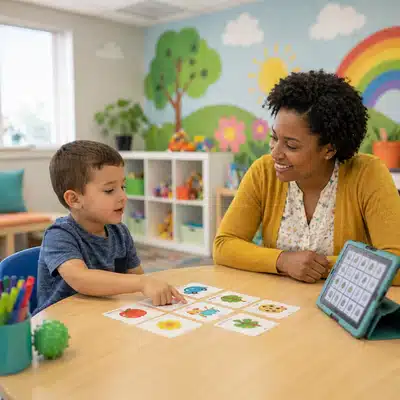
Speech therapy services are flexible. The right setting depends on your child’s goals and your family’s needs.
One-on-one sessions are usually the best for setting up AAC, working on speech sounds, and motor speech. Small groups can help kids learn how to talk to and interact with other kids. Therapy at school helps kids do well in class and learn. For families who need more flexibility, teletherapy is also a good choice. A 2026 meta-analysis by Vanderauwera et al. found that online speech-language therapy for kids under 12 worked about as well as, and sometimes better than, therapy in person.
Progress is measured by:
- Accuracy on target sounds or language goals
- Functional communication in real settings (home, school, play)
- Parent and teacher ratings of participation and behavior
- Literacy-linked skills like retelling and listening comprehension
Most children show meaningful gains within a few months when sessions are consistent and skills are practiced at home.
Will my child just grow out of it?
Some mild delays resolve on their own, but persistent language disorders are linked to broad academic and social difficulties. Waiting can increase risk, especially when a child is already showing signs of frustration or falling behind.
Can speech therapy really improve behavior?
Yes, particularly when the behavior is motivated by communicative dissatisfaction. According to research, language intervention can enhance teacher-rated behavioral adjustment, and functional communication training has a great track record of lowering problematic behaviors in children with major communication needs.
Does AAC prevent youngsters from talking?
No. AAC has repeatedly shown in research to support, rather than replace, speech development. It provides children with a reliable way to communicate while their speech abilities develop.
How long does therapy take?
It is determined by the child’s needs, severity, and consistency in practicing skills outside of sessions. Many families notice early success within a few months, with continued goals altered as the kid matures.
What if my child is bilingual?
Keep using your home language. ASHA clinical guidance supports culturally and linguistically responsive care. Dropping the home language is not recommended and can be harmful to family connections and development.
How do I know if my child needs an evaluation?
If your child is difficult to understand, avoids talking, struggles in school, has frequent meltdowns, or appears to be behind peers socially or academically, an examination is a good next step. Early intervention leads to greater results.
Precision Speech Therapy in Forney provides licensed Speech-Language Pathologists, led by Holly Steinke, who have training and experience in pediatric language, feeding, AAC, and communication care. That background enables us to create tailored, evidence-based strategies that promote success at home, school, and in daily life. Children benefit from improved communication in more ways than just clearer speech. They acquire tools for learning, connection, and confidence.
If your child is struggling to be understood, follow directions, eat safely, or keep up in school, schedule a pediatric speech evaluation with Precision Speech Therapy today and get a clear, personalized plan for what comes next.
Article written by:
Recent Posts