Blog
Speech Therapy for Preschoolers: Development Milestones Every Parent Should Know Before
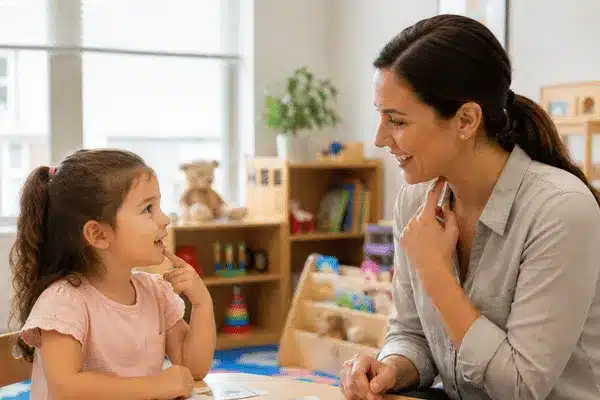
Speech therapy for preschoolers helps children ages 3 to 5 improve speech, language, social skills, and early learning skills. It can help when a child is hard to understand, uses short sentences, avoids talking, or struggles to follow directions.
Parents do not need to wait and see. The CDC says families should act early when a child misses milestones. Early support can give children more time to build the skills they need for kindergarten.
Table of Contents
What Is Speech Therapy for Preschoolers?

Speech therapy helps children communicate better in daily life. It is not only about saying sounds correctly.
Speech means how a child says words. This includes sounds, voice, and fluency.
Language means how a child understands and uses words. This includes vocabulary, sentence length, questions, stories, and directions.
Some preschoolers need help with speech sounds. Others need help using longer sentences, answering questions, or talking with other children. Some children also need support with feeding or social communication.
A licensed speech-language pathologist checks the child’s needs first. Then therapy is planned around the child, not a one-size-fits-all program.
Speech Therapy for Preschoolers and Kindergarten Readiness
Preschool communication skills matter because they support early school success.
Children need language to ask for help, follow class routines, listen to stories, answer questions, and play with peers. These skills also connect to early reading.
The National Institute on Deafness and Other Communication Disorders says developmental language disorder affects about 1 in 14 children in kindergarten. It can affect speaking, listening, reading, and writing.
That is why early support matters. Speech therapy for preschoolers can help children build stronger communication skills before school starts.
Preschool Speech and Language Milestones by Age
The CDC milestone guidance gives parents helpful signs to watch. These are not tests, but they can show when a child may need support.
| Age | Many Children Can Do These Skills |
|---|---|
| 3 years | Have at least two back-and-forth exchanges, ask who, what, where, or why questions, say their first name, and describe an action in a picture. |
| 4 years | Use sentences with four or more words, talk about something that happened earlier, repeat parts of a song or story, and answer simple object-use questions. |
| 5 years | Tell a story with at least two events, answer simple book questions, keep a conversation going for more than three turns, and notice simple rhymes. |
Most people should understand a 3-year-old most of the time. By age 4 and 5, speech should be clearer and easier to follow.
A child may still make some sound errors. But if they are often hard to understand, an evaluation can help.
Signs Your Child May Need an Evaluation
Ask for help if your child shows one or more of these signs:
- They are hard to understand most of the time
- They use very short sentences for their age
- They rarely ask or answer questions
- They struggle to follow simple directions
- They avoid talking with adults or other children
- They repeat sounds or words often when speaking
- They seem frustrated when trying to communicate
- They have feeding or swallowing concerns
Hearing should also be checked. Even mild hearing loss can affect speech and language growth.
Parents can ask for an evaluation even if no teacher or doctor has raised a concern.
Is Bilingualism the Problem?
No.
Bilingualism does not cause a speech or language disorder.
What Experts Say
The American Speech-Language-Hearing Association says multilingualism is not a cause of speech or language problems.
Signs Across Languages
A child with a true language disorder will usually show signs across the languages they use.
What Is Normal
Mixing languages or knowing more words in one language than another is common for bilingual children.
A good evaluation looks at the child’s full language background, not just one language.
No. Bilingualism does not cause a speech or language disorder.
The American Speech-Language-Hearing Association says multilingualism is not a cause of speech or language problems. A child with a true language disorder will usually show signs across the languages they use.
It is normal for bilingual children to mix languages or know more words in one language than another. That alone does not mean there is a disorder.
A good evaluation looks at the child’s full language background.
How Parents Can Help at Home
Parents play a big role in daily progress. Small routines can build strong skills.
Try these simple ideas:
- Read every day. Ask simple questions about the story.
- Talk during routines. Name items while cooking, dressing, or driving.
- Play rhyming games. This helps children hear sounds in words.
- Model clear speech. Say the word correctly without forcing repeats.
- Give choices. Ask, “Do you want milk or water?”
- Build longer sentences. If your child says “big dog,” say, “Yes, the big dog is running.”
These activities support therapy, but they do not replace a full evaluation when a child is delayed.
What Happens During Preschool Speech Therapy?
Preschool therapy should feel natural and child-friendly.
Sessions may include:
- Pretend play
- Picture books
- Toys and games
- Songs and rhymes
- Drawing or matching tasks
- Parent coaching
- Home practice ideas
The goal is to help the child use skills in real life. That includes talking at home, in preschool, at the park, and with family.
Online therapy may also be an option for some children. The American Speech-Language-Hearing Association says telepractice can be used alone or with in-person care when it fits the child’s needs.
Finding Speech Therapy Support in Dallas

Families in North Texas can work with private clinics, schools, or both.
Forney-based care may be helpful for families looking for Dallas speech therapists near East Dallas, Kaufman County, and nearby areas. Many families also search for Dallas speech pathologists when they need speech, language, stuttering, feeding, or social communication support.
Texas families also have a public option. Through Child Find, parents can ask their local school district for an evaluation if their child is at least 3 years old and may need special education services.
Children under 3 may qualify for early childhood intervention through a separate Texas program.
At what age is it best to start speech therapy for preschoolers?
Children can start as soon as a delay is noticed. Ages 3 to 5 are important because children are building skills for school. Early help can support speech, language, play, and social skills before kindergarten.
How do I know if my 3-year-old needs speech therapy?
Ask for an evaluation if your child is very hard to understand, rarely asks questions, or does not use many words together. Also, watch if they struggle to follow simple directions. A speech-language pathologist can check speech, language, play, and hearing concerns.
Can speech therapy help with reading readiness?
Yes. Speech therapy can support vocabulary, storytelling, rhyming, listening, and sound awareness. These skills help children prepare for early reading. Therapy can also help children answer questions and talk about books.
Is online speech therapy okay for preschoolers?
It can work for some children. Online therapy depends on the child’s age, attention, goals, and family support. Some children do best in person, while others do well with a mix of online and clinic sessions.
Is a motivational speech for teenagers the same as speech therapy?
No. A motivational speech for a teenager is usually meant to inspire or encourage a teen. Speech therapy is a clinical service for communication, speech, language, fluency, voice, feeding, or social skills. It is planned and led by a trained speech-language pathologist.
Should I wait until kindergarten to ask for help?
No. If you are worried, ask for help before kindergarten. Preschool is a key time for speech and language growth. Early support can help your child feel more ready for school.
Speech and language delays are easier to support when they are found early. If your preschooler is hard to understand, avoids talking, or misses key milestones, an evaluation can help you understand what is going on and what to do next.
Precision Speech Therapy supports children with speech, language, stuttering, feeding, and social communication needs through child-friendly care. To learn more or take the next step, visit their speech therapy for children page and schedule support for your child today.
Article written by:
Recent Posts