
Blog
Private Speech Therapy vs Speech Therapy Clinics: Which Is Best for Your Child?
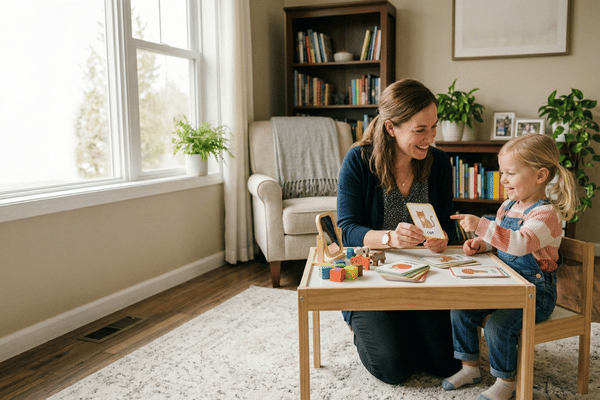
If you’re trying to decide between private speech therapy and speech therapy clinics for your child, you’re not alone. Many parents face this exact choice. Both options use licensed therapists. Both options can support progress when the care plan is appropriate for the child’s needs. The right fit depends on your child’s age, goals, and your family’s schedule.
Table of Contents
What Is Private Speech Therapy?

Private speech therapy is delivered at home or online through video sessions. A licensed speech-language pathologist (SLP) works one-on-one with your child in a familiar setting.
Key benefits include:
- No commute required
- Flexible scheduling
- Parents are part of every session
- Skills are practiced in real, everyday situations
The American Speech-Language-Hearing Association (ASHA) confirms that telepractice is an appropriate and effective model for speech-language services. Private speech therapy works well for speech therapy children of all ages, especially toddlers and those with sensory sensitivities.
What Are Speech Therapy Clinics?
Speech therapy clinics have scheduled sessions in a professional, organized setting. Clinicians have access to special tools, group sessions, and sometimes teams made up of people from different fields.
Benefits of clinic-based care:
- Structured, distraction-free environment
- Access to specialized equipment
- Group therapy options for social skills
- Multidisciplinary care under one roof
Clinics are ideal for school-age children who require peer interaction or more specialized environments. Travel, wait times, and a lack of parental engagement during sessions are all common downsides.
How Do Outcomes Compare?
Some research suggests telepractice and in-person speech therapy can lead to comparable outcomes for certain children and goals, but results vary based on the child, therapist, consistency, and family involvement. ASHA’s evidence summary confirms that telepractice and in-person pediatric speech therapy produce similar improvements on both clinician and patient measures.
Parent involvement is one area where private speech therapy has a clear edge. When parents watch and participate in sessions, children generalize skills faster. Research on early intervention consistently shows that parent-coached models produce better long-term language outcomes than child-only approaches.
Cost and Insurance

The costs of private speech therapy and clinic-based care are about the same. Most commercial insurance plans will pay for pediatric speech therapy if it is medically necessary. Medicaid pays for kids who qualify in both places. Medicare will pay for telehealth SLP services until at least 2027.
Before you start, always check to see if you have coverage. Talk to your provider about what kinds of insurance they accept and if your plan covers telehealth sessions.
Which Model Fits Your Child Best?
There is no single right answer. Here is a quick guide:
Choose private speech therapy if your child:
- Is under age 5
- Has autism or sensory sensitivities
- Lives in a rural or underserved area
- Learns best in a calm, familiar setting
Choose speech therapy clinics if your child:
- Is school-age and goal-driven
- Needs group or social communication practice
- Requires specialized diagnostic equipment
- Benefits from a structured, clinic-style routine
A hybrid approach works too. Many families start with in-home or telehealth sessions and add occasional clinic visits for assessments or group work.
| Point | Private Speech Therapy | Speech Therapy Clinics |
| Setting | Done at home or online in a familiar space | Done in a structured clinical setting |
| Schedule | More flexible and easier for busy families | Fixed session times with possible travel |
| Parent Involvement | High parent involvement during sessions | Usually less parent involvement during sessions |
| Environment | Comfortable and natural for daily skill practice | More controlled and distraction-free |
| Tools and Services | Focused one-on-one care in real-life settings | May offer special tools, group sessions, and multidisciplinary care |
| Best For | Younger children, sensory-sensitive kids, and families wanting convenience | School-age children who need structure, peer interaction, or specialised support |
| Travel and Wait Time | No commute and often shorter waitlists | Travel required and wait times may be longer |
| Outcomes | Similar results to clinic-based care when consistent | Similar results to private therapy when consistent |
Whatever you choose, start early. ASHA emphasizes that many parents wait 6–12 months after noticing delays before seeking help. Early evaluation leads to better outcomes for speech therapy for children.
Is private speech therapy as effective as clinic-based therapy?
Yes. ASHA’s evidence confirms that private and telehealth speech therapy produce results equal to in-person clinic care. Outcomes depend more on therapist skill and consistency than on location.
How often should my child attend speech therapy sessions?
Most children attend one to three sessions per week, each lasting 30 to 60 minutes. Frequency depends on the severity of the delay and the goals outlined in your child’s treatment plan.
Does insurance cover private speech therapy?
Most major insurance plans cover pediatric speech therapy in both settings when it is medically necessary. Coverage for telehealth has expanded significantly and many plans now include it. Always verify with your provider before starting.
How long does speech therapy for children typically take?
Duration varies based on the child’s diagnosis and goals. Many children participate in 30 to 50 sessions before reaching their primary goals. Your SLP will reassess progress regularly and adjust the plan as needed.
What age should my child start speech therapy?
Children can begin speech therapy as early as infancy. Early intervention services are available for children aged 0 to 3 through state programs at no cost to eligible families. The sooner treatment begins, the better the outcomes.
Can parents participate in private speech therapy sessions?
Yes, and it is strongly encouraged. Private speech therapy naturally includes parents in every session. This helps you reinforce skills at home, which is one of the strongest predictors of faster progress.
It’s important to choose between private speech therapy and speech therapy clinics, but it’s just as important to choose the right provider. At Precision Speech Therapy, our licensed, certified, and master’s-trained speech-language pathologists provide individualized care to every child and family we serve. We offer support in the clinic and through teletherapy. We make treatment plans that are based on real evidence and fit into real family life. This way, your child can make progress where communication is most important.
Do not wait and hope your child will simply outgrow a delay. Book an evaluation with Precision Speech Therapy today and get a clear, personalised plan that helps your child communicate with more confidence at home, in school, and in everyday life.
Article written by:
Recent Posts